Hope on the line

Heavy rains continue to fall in Haiti, slowing the recovery of people in hurricane-affected regions. But there is hope.

img_2179

I’ve been back in Haiti less than a month, and already it’s been a whirlwind. With a lot of help from good friends, I moved into a new home, met Almand who is here to serve as “guardian,” someone whose primary job is to keep us safe and whose secondary mission is to become part of our family.

Paul Sinette continues to care for me — she has to be the best cook in Haiti, and she helps me navigate life. Her son Carlens is often here, playing Dominos with Almand.

They all teach me Creole, learn English from me and we take turns saying Grace.

It’s a good deal.

We welcomed a kitten to the house about a week ago. Kimberly, named by Paul Sinette, pretty much runs the place and brings much entertainment.

As you know, Hurricane Matthew did a number on several parts of Haiti, especially to the southern peninsula. The storm hit Oct. 4 and 5. The second weekend of November I was able to visit the South and Grand Anse departments that suffered catastrophic damage.

Fabienne Jean, coordinator of our network FONDAMA, and I traveled to Les Cayes and then onto Grand Anse to visit with partner organizations and also Luke Osikoye, international associate with Presbyterian Disaster Assistance.

Passing Grand Goave on National Route 2, we began to see the damage Matthew left behind. The bridge at Petit Goave was washed out, and a detour was in place while workers replaced it.

Torrential rains have continued in the region, so beyond the obvious hurricane damage — destroyed houses, roofless homes and trees devoid of leaves and branches — we passed flooded roadsides, yards and fields.

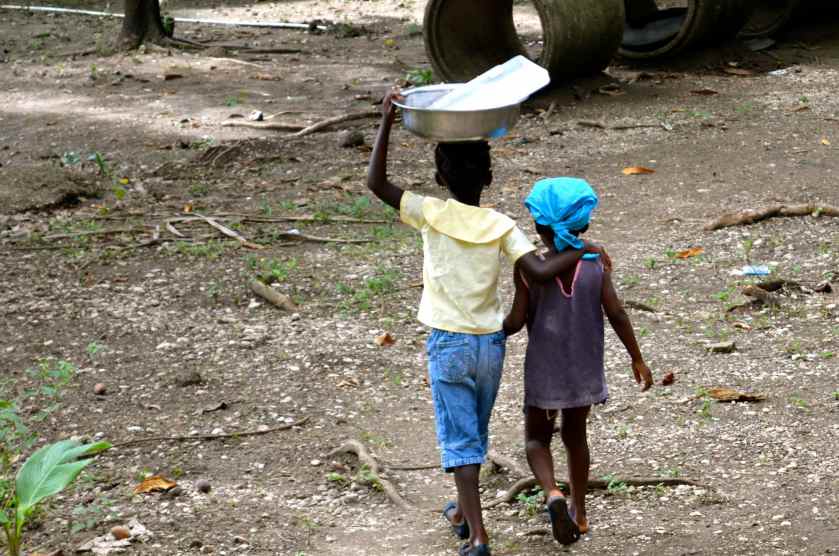
Farmers who had access to oxen used them to plow fields. People of all ages walked the roadways carrying water, food and construction materials.

We passed a number of funerals — people wearing black and white, walking slowing in small groups. On the national highway outside of Les Cayes a beat up pickup carried a casket and followed a five-person brass band while friends and family of the deceased followed on foot.

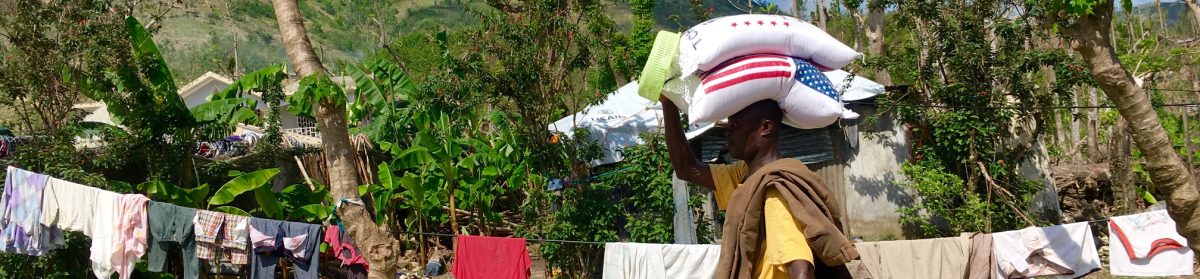
In Moron and Marfranc, World Food Programme and USAID were handing out bags of rice and tarps. In both villages, people lined up in the hot sun to wait. We saw dozens of people carrying their aid home — many of them waste-deep through overflowing rivers.

The further we went, though, and the closer we got to the village of Chambellan located near the southern peninsula’s tip, I saw the bits of hope.

Clothes and sheets and underwear, washed in whatever water was available and simply hanging in the breeze.

Red blouses, green slacks, blue jeans, multi-colored sheets — waving as if a grand sign that in spite of it all, life goes on.

In clean clothes.

I will have more to tell you soon, including ways you can help. FONDAMA is working on a proposal through PDA to help people in these communities with recovery.

Please know that you are appreciated — for caring, for reading and for continuing to pray for all the people of Haiti and those around the world.

God bless.

Won’t be long now

img_2443I’ll be heading home soon

Their lives are built on poorly constructed roads. Or dust and rocks. Their lives are shaky, just like their homes made of blocks with too much sand, too little cement.

They work so hard, but are not employed. Not in the way we imagine. With job sites and time cards. Their work begins before the sun peeks above the horizon. In cities or villages or in clusters of homes far away in remote mountains.

Cleaning. Searching out food. Cooking what little they have. Sending children to school.

If they’re lucky.

The lives of the Haitian people are tender and unstable most days, but they are not unrooted.

No. The people of Haiti rise each morning, stretching sore muscles into another long day, anchored in the history and tradition of a people who won freedom from slavery while they still were in chains.

I am grateful to have been “home” in the U.S. for all these months. I still have a few presentations to make, even a sermon I am writing for my own home church.

But as September winds into October, I am preparing to head back to my other home.

Where people struggle daily with poverty and hunger and political and social instability.

And once again, I will join forces with them as they work together to make their lives better.

The fight for Haiti’s independence from slavery began 225 years ago, but the spirit of revolution still lights in their eyes.

Please keep all of us in prayers, friends.

Long way home

Quiet. So quiet.

DSC_0128
A young buck considers why there might be a stranger in his yard at Natural Tunnel State Park, Duffield, Va.

It feels like a confession. It has been nine months since my last blog post.
And I feel terrible about that. Truly.
I’ve been in the U.S. since May. I’m traveling to visit Presbyterian congregations and other groups about our work in Haiti. Even though I have traveled back to my U.S. home more than many mission co-workers are able to do, a multi-month stint here is — at best — startling.
I have just now found my first-country rhythm. And it has been busy. I spend a lot of time on the highways and country roads traveling to visit churches in several states.
I am spending a great deal of time with family, which is precious, but it makes me miss my Haiti friends and “family.” I am afraid I’m losing what little ability I had in Haitian Creole.
And I am trying to keep up with what is going on back in Haiti at the same time.
So about mid-way through my time here in the U.S., my best friend and I headed out on a week of respite. We traveled to the southwestern tip of Virginia to a state park where we spent our days relaxing at the pool, visiting small towns whose names end with Gap and enjoying the wildlife that appear in laid-back rural regions.
A handful of deer grazed on the lawn of the cabin where we stayed. Wild turkeys roamed through the wooded areas. A small turtle who crossed the road declined my efforts to direct him (her?) to safety.
In other words, in the all the hustle and bustle of traveling and speaking and preaching and praying, this week of respite was a true vacation.
And all of it gave me time and space to remember that I haven’t made a blog post in nine months! Unacceptable!
And in that realization, I thought about the title I gave this blog years ago when I traveled to Haiti to live and work.
The long way home.
I am so grateful to have two countries I now can call home.
I am grateful for the families who have taken me in during my journey — people who are in one moment strangers, and by the time they show you where to find the extra toilet paper, you suddenly are close friends!
This whole journey has been like that. I traveled into a foreign country and was received with great kindness and joy.
Then I traveled back to my home country, and strangers here receive me the same way.
It reminds me again and again how this Christian gig works — first we are strangers, then we find connections.
First God loved us, and then we connect with all those others who he loves.
And in the quietness of Natural Tunnel State Park, in a place so slow that wildlife checks us out as whether we should roam freely, I remembered all of this again.
I’m back to blogging. My stories are about Haiti and about this wonderful home of ours.
I’m grateful to be among you all.

Photo by Jackson


Jackson photo of teacher
A professor at the CODEP school. Photo by Jackson.


“Li pa bon,” Inez told me quietly.

He’s not good.

Jackson already had found me as a willing compatriot. He was eating fried fish from a small pink and white striped bag commonly used by food vendors on the street. The shape of his eyes and ready affection let me know he was not a student at the school.
“Oh, he’s good, all right,” I smiled at Inez who still looked worried.
No, he doesn’t speak much. And yes, he is intellectually challenged.
But Jackson is good. Jackson is great.
Realizing that I understood Jackson’s situation, Inez smiled broadly as the 13-year-old and I communicated through a few words and lots of gestures. Inez understood that I cared, that I wouldn’t smile at the boy then shove him away.
If you know what it is to be seized with joy, then you know my heart in Haiti.
It’s hard here. No doubt. The struggles of the people in this tropical land are well publicized. Very often, an American’s first thought when the word Haiti is mentioned is of pity. How can so much hardship happen on people who deserve so much more?
Government corruption leads to hunger, lack of schools and adequate housing. Drought and land grabbing brings misery to those who once were able to eat from their own gardens. Deforestation means dramatic changes in weather patterns, hotter weather, less rain and fewer chances for shade from the scorching sun.
And in it all there are so many connections made between people — people helping people. And in witnessing that, I find my greatest source of joy.
I was with Frank Dimmock, a colleague from Presbyterian Church (USA) World Mission. Frank was in Haiti visiting schools as part of his understanding of education in the countries in which mission workers serve around the world.

We were visiting Institution Mixte de Duclo, a junior high school in the South of Haiti operated by CODEP, a community development project predominantly supported by Presbyterians. While the 42 students were busy in the classrooms, Jackson wandered around. He seemed very happy to greet us as visitors.

And having finished his meal, he asked me for money to buy something to eat.
“You just ate,” I teased him. He grinned and Inez grinned and Jackson’s attention quickly turned to something else.

Jackson taking a photo
Jackson taking a photo of Frank Dimmock and Marc Charles. With a little help from a friend.

My camera.
His first request, through gestures was for me to take a picture of him. But that wasn’t enough.
It was clear Jackson was ready to become the photographer.
With the strap of my Nikon around his neck and a few instructions, he was ready to go.

jackson frank shooting pic
Frank Dimmock taking a photo of Jackson taking his photo. Marc Charles, our friend and translator, in the striped shirt.

And he went, snapping photos of the students, then hurriedly stepping into the classrooms to show the girls the photos he had taken.
The students howled with laughter and encouragement. Jackson beamed.

Jackson photo of school
One of Jackson’s photos of Institution Mixte de Duclo, a CODEP school in the southeast of Haiti.

The leaders of CODEP who were with us grinned. And Inez laughed along with us.
That’s when it hit – as it so often does – the seizing of my heart with happiness.
In places like Haiti where surviving takes a lot of effort and thriving takes a lot of help, the Jacksons of the world are among the most vulnerable. Often they are pushed to the sides of the community, cared for, but not given the support we all need. The mentally disabled often are the “least of these” in poor communities.
But here in this small, very well built junior high school, a boy with challenges greater than many, is loved, cared for and a part of the community.
Let Jackson teach us again – the “least of these” is in no way connected to “lesser than.”

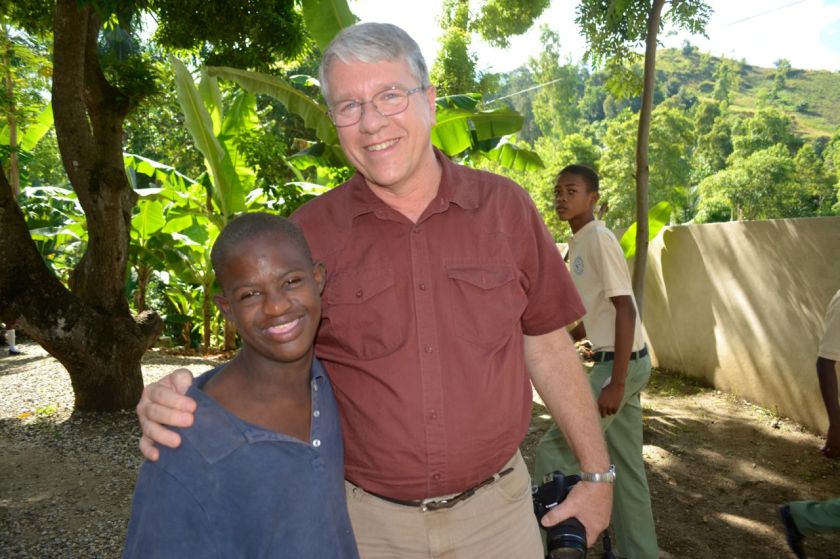
Jackson with Frank
Jackson and Frank.

Thank you, my friend, Jackson for sharing time with me on Friday.
And thank you, community of Institution Mixte de Duclo and CODEP for caring for our sweet friend.
P.S. While Jackson didn’t get any money for food that he was requesting from us, he found his way to the vehicle where he hit up our driver, Johnny. And he happily walked away with the cookies Johnny found for him. Photography is great, but cookies?
Well played, Jackson. Well played.

Courage is the word

Learning Haitian Creole, traveling Haiti and meeting up with Jesus all along the way.

I’ve just returned to Haiti from two weeks in the U.S. It was different this time. I had traveled with my sweetie, Papoush, so maybe I didn’t miss my home in Haiti as much as I usually do. Or maybe after two years living here, coming home feels more normal now, not quite as over-the-moon exciting.
But once in the vehicle, bumping along on the road to my house, I remembered (again!) why I am so attached to this country.
I saw my neighbors living out there days as they do. Walking back and forth from market. Young fathers tenderly holding babies. Market women catching a quick nap between customers. Children hollering at one another across the busy streets.
And in their faces I saw the quiet desperation. Hard times mean scrambling every day — for another sale from their curbside market, for a few gourdes to buy rice and beans, for a bit of shade to escape the heat and humidity.

But also — that other bit you always can find in the face of a Haitian.

Courage.

It’s the fierce power of persistence. It’s what keeps my neighbors going. Every minute. Every day.

I admire my neighbors. And I must become more fierce to help them make the lives better.

I must find the courage to stay out of my comfort zones I so easily can find when they cannot.

Our Joining Hands network here will be examining what we need to do to meet our goals over the next few years. While we wait out the Election season that no doubt will bring more disorder, but hopefully will bring new hope, we ask for your prayers that we evaluate and plan for our network’s next steps.

We covet your prayers. And we appreciate all your support.

More to come!

Priye a ap monte. Gras la ap desann!

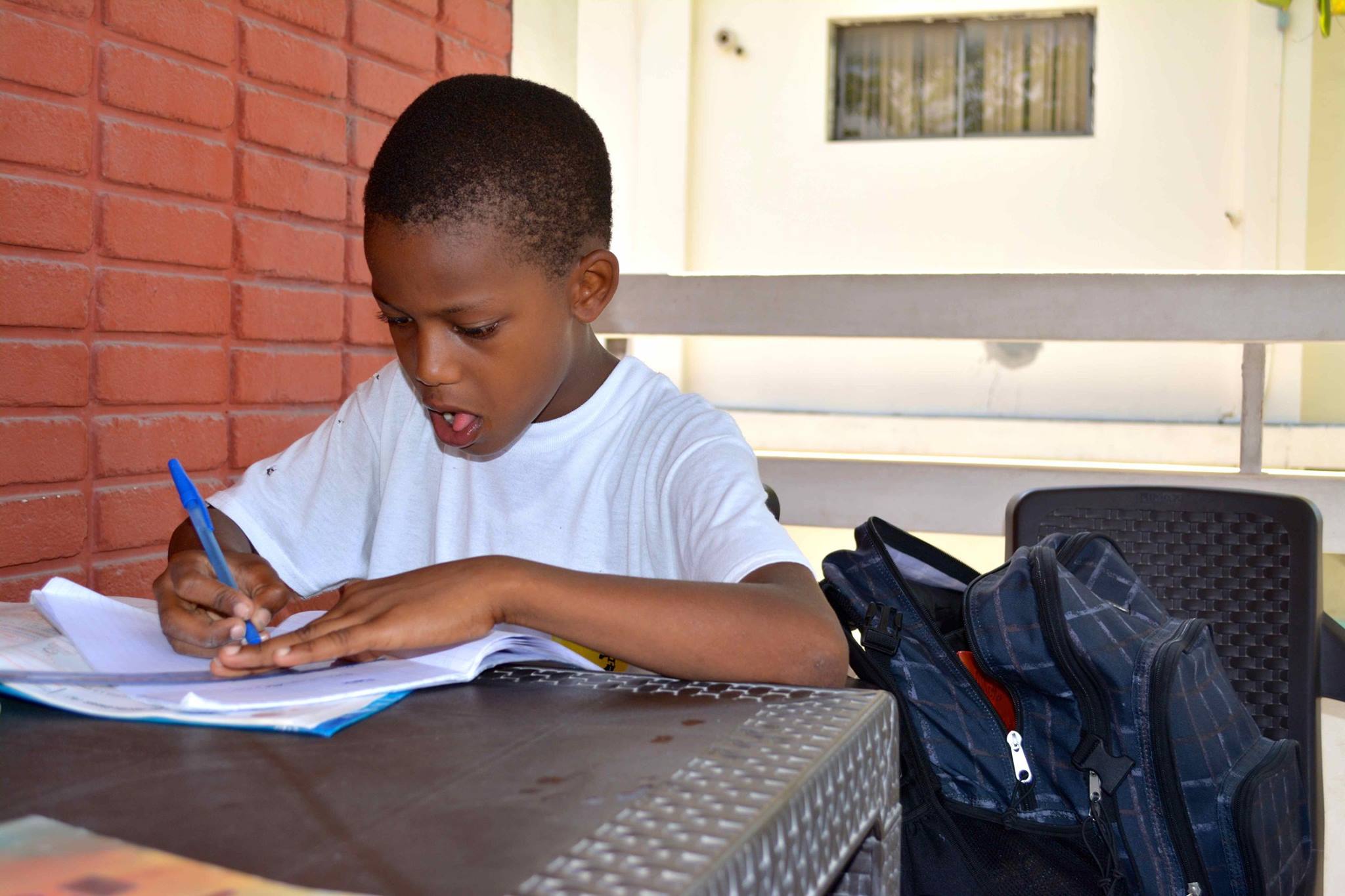
Carlins, 9, hard at it. He spends a lot of time on homework, and his report card proves it!

WARNING: Big ol’ missionary confession coming.
The concept and practice of prayer simply confounds me.
Oh, I pray, don’t get me wrong. I often pray out loud. I pray in two languages now, adding Haitian Creole to my repertoire. And I pray each night before I sleep.
Mostly, though, it seems like talking to a friend. I mean, I pray for change: Please help the little baby in surgery today.
And I pray out of my own personal, sometimes ridiculous-seeming needs: Dear Lord, please help me get my work done tomorrow!
And I send out urgent requests: “Dear God, in the name of everything that is holy, please get that gigantic tap-tap heading right toward me back in its lane …. OK. Whew. Thank you, God. Amen.”
And sometimes what I’ve prayed for happens. And sometimes it doesn’t. It’s not like I go back and check. So, often, I’m surprised when things turn out well.
That’s the confession. Shouldn’t prayer and faith be more closely connected? If my faith is strong, should I ever be surprised?
Anyway, the other night, in the midst of several texts with a friend, I was surprised again. Enough to give me pause. My friend is a young guy. He’s a husband and has a 10-year-old daughter. He is starting a small tree nursery in his small yard. He works very hard, but his project takes a lot out of him. In Creole, he wrote that his nursery was doing well, but that it was a long way to the river and back, and he needed to fetch water for the small plants because it hadn’t rained in a while.
So, I, like a good missionary, wrote that I would pray for rain. But it’s not like I stopped right there and went through the motions and said the words. I just wrote that I would pray for rain for my friend’s region.
And in his next text, Givenson said that a gentle rain had started.
Right then. Just as I wrote those words. And you can call it is a big ol’ coincidence. Or you could call it God looking over our shoulders and reading the texts ….
Or, as I am doing, you could understand that rain very often is an answer to prayer.
Just like the ferocious looking tap-tap heading my way moving just in a nick of time, I felt great relief at Givenson’s news of rain showers.
It happened again this morning.
I had just posted on Facebook about 21 men and women who died when the boat they were fleeing Haiti in sank in stormy weather. More than dozen people still are missing. And this came a week after six people died in flooding in Port-au-Prince.
Where’s the hope? The people in the boat had lost hope in Haiti, so they set off in search of it somewhere else.
As expected, several of my friends on Facebook immediately responded, sharing the post, sending prayers. And, yet, my heart was sinking and searching for the hope.
That was when my friend and housekeeper Paul Sinette came in the door. As soon as we said “bonjou,” she pulled open an envelope and showed me what was inside. Her 9-year-old son’s report card.
Carlins has done well this session! His grades are improving! I shared her joy.
I share her pride.
And, so much more than that, I share Paul Sinette’s hope.
And like a prayer that went up, the answer came in the door in that little envelope, marked in little boxes and shining in the huge grin on this mother’s face.
And here’s the Good News!
Last weekend we yelled Hallelujah! Last Sunday, we sang, “Jesus Christ has risen!”
And today, and tomorrow and through eternity, He still is risen!
Such good news. Wrapped in hopes and sent in prayer, we find it every moment of the day.
As the Haitian proverb goes, “Priye a ap monte, gras la ap desann!”
The prayer is going up. The Grace is coming down!
The challenge, as always, is to recognize it!

Clean hands, full heart

handwashingAn acolyte pours water over the priest’s hands before the priest consecrates the bread and wine for Holy Communion.
I watch this tiny part of the Mass with as much intensity as I do any of it. It is no less important than the consecration, the serving or even the consumption of the Body and Blood of Christ.

We come to serve with clean hands.

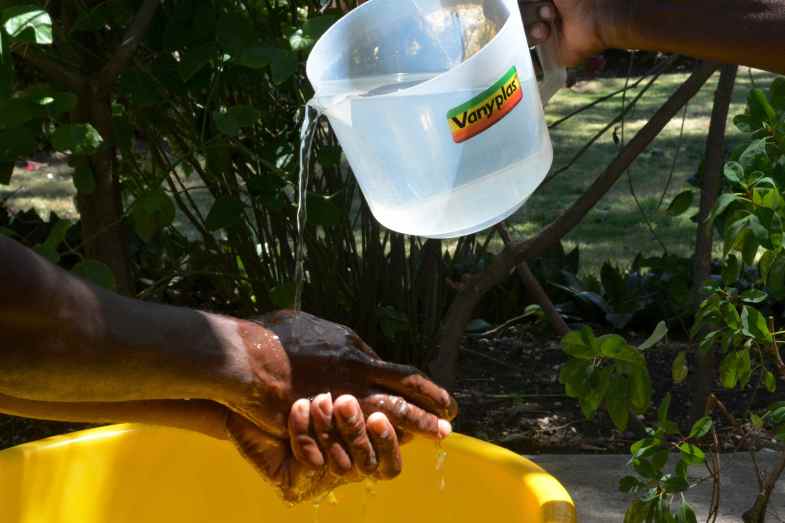
In rural Haiti, where there is no place with running water to clean up before eating, I often am approached with someone holding a pitcher, a sliver of soap and a container to catch the stream of water as I rinse my hands. The person holding the pitcher and soap pours enough water so I can wet my hands, then offers the soap, takes it back and pours again for me to rinse.

The water is cool against my warm hands. The pourer watches carefully so he or she does not waste water. As I shake my hands dry, I always feel the emotion of this ordinary moment.

It is intimate, deeply personal, almost holy.

The first time someone poured water for my private hand washing, I had just arrived at Papa Luc Celestin’s home. I felt overwhelmed with all that being an honored guest entails, and I still was struggling to deserve such attention.

Papa Luc’s son, Herns, was holding a pitcher of water when he brought a small tub to me while I sat at the head of the humble table filled with warm Creole food. He motioned for me to hold my hands under the stream of cool water. I rinsed my hands, lifting my head to watch Herns carefully instruct me. He handed me a clean towel, and when I turned to the table, already I was overcome with emotion.

Thus began my missionary training.

Serving another is not a skill. It is simply providing what is needed in the moment.

Throughout this country, when I have the chance to eat in the most rural area, I welcome the chance to help someone else wash and rinse his or her hands.

Service is not an obligation. It is an honor.

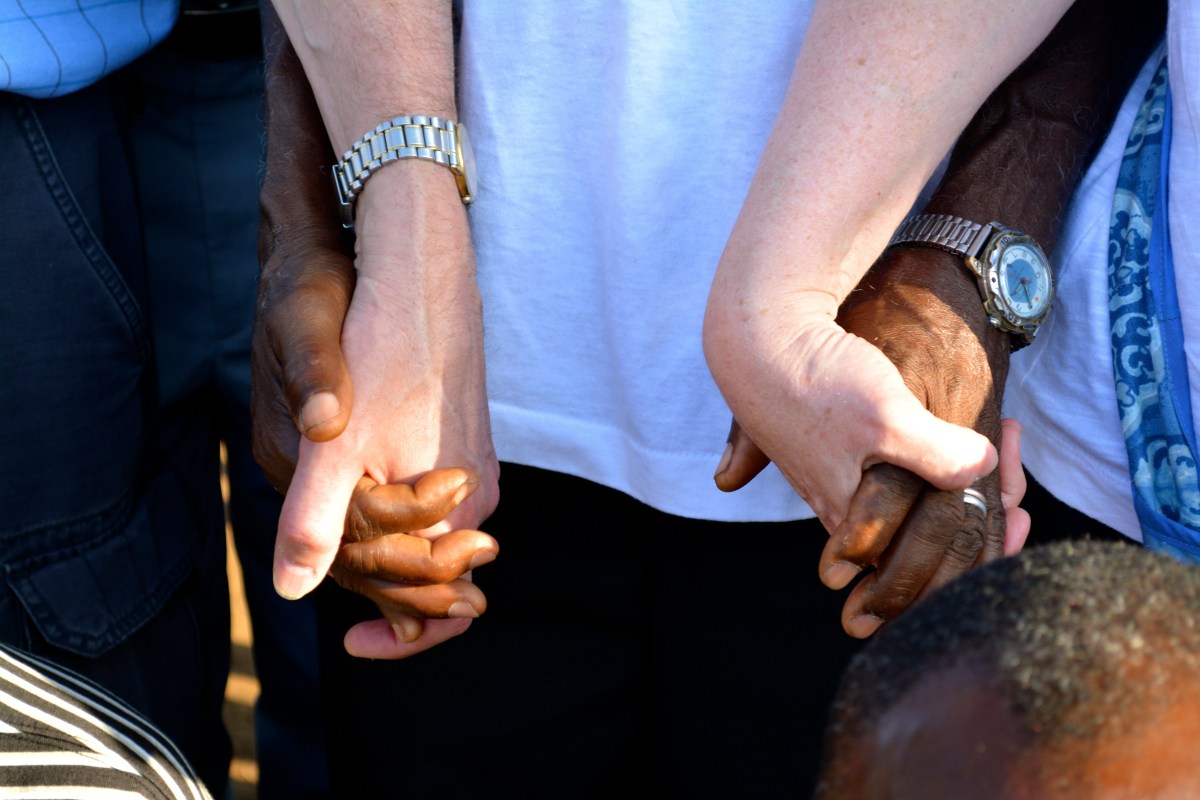
And when we all have shaken the last of the clear water from our fingers, we clasp hands to pray and then to enjoy God’s bounty. Together.

The garden gives you life

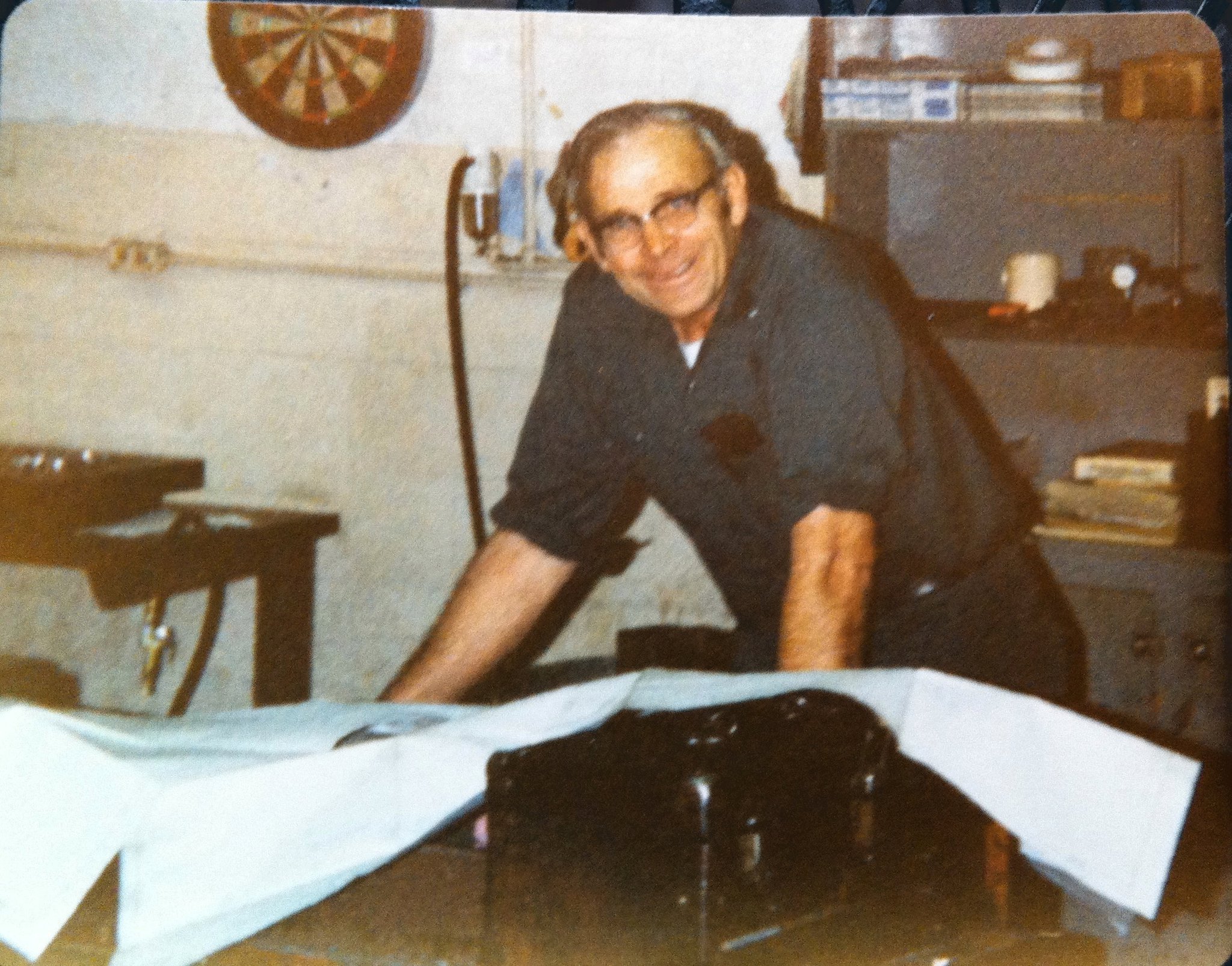
Andy Corell working at his other job — as a machinist. Circa 1975. (Photo by Jeff Ellinger)
Andy Corell working at his other job — as a machinist. Circa 1975.
(Photo by Jeff Ellinger)

I’ve grown accustomed to seeing my mother on a regular basis. Like anytime I catch a glimpse of myself in a mirror. She’s with me wherever I go, perhaps even more closely since she died in 1998.

What’s more surprising to me is seeing Dad. Not in a mirror, but in the expression of a friend here, in a chuckle or in the barely noticeable limp of a hard-working man walking past me.

He’s been gone even longer. He died in 1990. But by all accounts, he got to Haiti before I did.

I told the story again today. I enjoyed lunch with two farmers from high in the mountains above the Artibonite River and a colleague who lives near me in Port-au-Prince. Andre Ceus and Lormè Previlus came to the capital city on business, and the four of us caught up at my house for lunch.

Fabienne asked me about my home in Virginia, and I explained that I grew up on a farm in the countryside of Virginia, in a great valley. I went on to tell them that my father had been a farmer, even though he had been wounded in World War II and lost his right leg below the knee. Farming was his love, so he worked hard to continue the way of life he’d been born to.

“My father had the biggest garden ever,” I exaggerated. Slightly. “And I hated working in the garden.”

Dad’s gardens encompassed a good quarter acre. At least that’s how large it looked when I was 10 and it was summertime and I was expected to pick beans or pull weeds and the neighbor kids were watching television.

Hated. It.

They laughed as expected, then Lormè, a man about 45 but looking older, leaned over the table and gently reminded me in his native language: “But it is the garden that gives you life.”

I nodded, taken aback just a bit by the sound of my father’s voice speaking Creole.

Dad worked a full-time job and farmed on the side. Money was tight in the ‘60s and ‘70s. That garden provided much of our food during the summer, and we enjoyed potatoes from it long into winter.

“I liked eating from the garden,” I replied. “I just didn’t like working it.”

“Your father is smiling at you now,” Fabienne said with a smile of her own.

And I had to agree. My life’s calling has brought me to Haiti where I work with men like Andre and Lormè and Papa Luc, all of them farmers who depend on their land to provide food and extra income for their families. Like my father, they cherish the land they toil. Like my father, they keep their spirits up even in the toughest times by telling stories  — and listening, too.

And like my father, to them, family and farming are one in the same.

Lormè isn’t the first to bring my father to mind here. Papa Luc Celestin and his family hosted me for the first month I lived in Haiti. He, too, farmed, worked in carpentry and walked with a limp. “If your father was alive, would he visit Haiti?” he once asked me.

“I don’t know,” I said. “But I know I would have a lot of questions from him.”

And I would. And he is here. And he is smiling.

And you know what, Dad?

So am I. I am eating from gardens as beautiful and as essential as yours. I am so grateful for all.

ac·com·pa·ni·ment

Accompaniment is about more than sharing the road. Accompaniment is about sharing our lives, our gifts and hardships toward a more complete life together.

accompaniment“You keep using that word,” goes the brilliant quote from Inigo Montoyo in the film, “The Princess Bride.”

” I don’t think it means what you think it means.”

And no, I have not been saying “inconceivable” at every turn. The word that keeps coming to my mind and entering into my conversations is “accompaniment.”

I’m new at this missionary business. Feeling called and doing the work of the called are worlds apart. Just like everything I’ve learned about my life and this new, astounding, baffling, magnetically attractive culture in which I’m living.

I’m here to be with you, my brothers and sisters. And when I am fortunate enough to host groups of short-term missioners visiting rural Haiti, I hear myself preaching “accompaniment.”

We are here to be with, not to do for. We come to walk alongside our friends here. We come to share our lives and our stories and find common ground.

A recent trip took us (seven people from the Presbytery of the James, two drivers, a translator and me) far into the mountains where we met with some of those friends. We had many excellent, deep conversations, both among ourselves, (we foreigners) and with the leaders and members of the farmer organizations we spent time with.

We talked about healthy giving. We talked about ways to help without hurting. We talked about these books we’ve all read, like Toxic Charity and When Helping Hurts.

We talked about finding ways to accompany the people here in Haiti.

I used that words so much I finally looked up the definition. You know, just in case I was WAY off the mark. The first definition concerns a musical accompaniment, as in adding the piano to the vocal parts. The second had to do with complementary additions — as in cooking.

Then, I found this. And I’m sticking with it. Because, dear Inigo, I think we’re onto something. Check out definition No. 3.

ac·com·pa·ni·ment

(ə-kŭm′pə-nē-mənt, ə-kŭmp′nē-)

n.

  1. MusicA vocal or instrumental part that supports another, often solo, part.
  2. Something, such as a situation, that accompanies something else; a concomitant.
  3. Something added for embellishment, completeness, or symmetry; complement.

Yes! It is about completeness.

I live and work in Haiti not to be the sole helper. I am here to be completed.

And, if you should come to be with, you will be on that path as well.

Because God is in this mix, as always. He is here for the journey, for the discussions, for the hard questions. And He is here when we visitors exchange funny looks with our hosts because we often don’t understand one another.

And only God will complete any of us.

The most excellent, conceivable part is that he puts us in touch with one another toward that end.

Today is Ash Wednesday. The beginning of Lent. And this day I begin to practice mindfulness. Part of that is examining the words I use, especially in nurturing beautiful relationships with my family and friends across a great sea and beyond a great cultural divide.

Look here for more of this journey.

Blessings abound.